

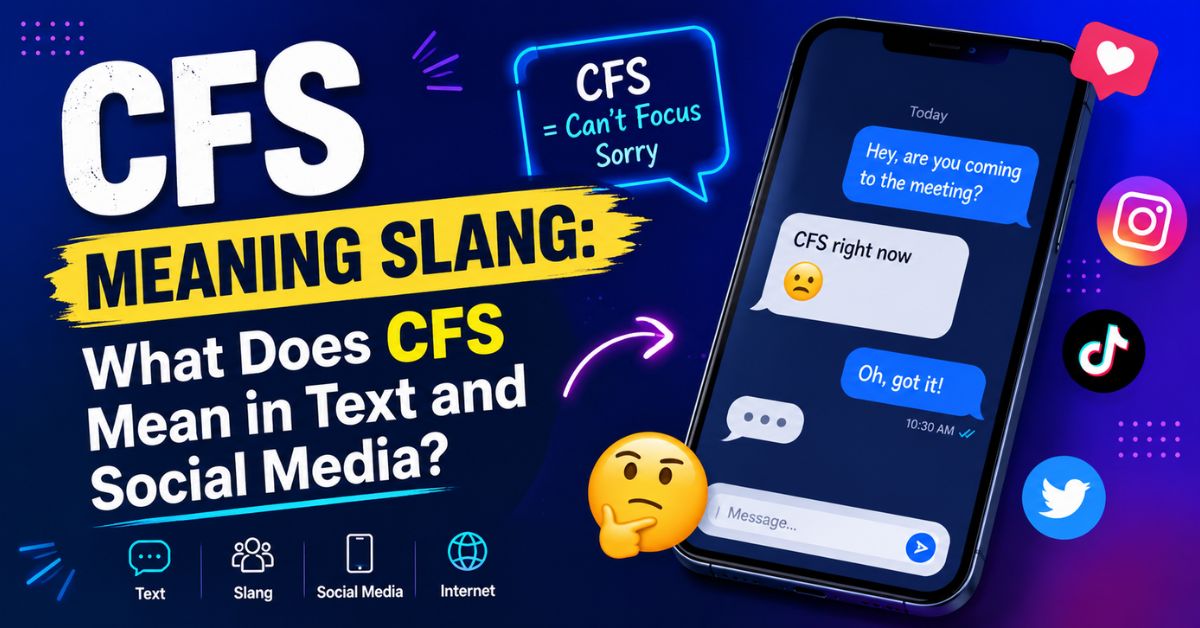
You’re scrolling through a group chat, and someone drops a text that just says: “CFS today, not leaving my bed.” No context. No explanation. Just three letters and a whole lot of confusion on your end.
If you’ve landed here trying to crack the code, you’re not alone. CFS meaning slang searches have spiked as the term pops up more and more in texts, captions, and comment sections. And here’s the thing: it doesn’t mean just one thing. Depending on who’s typing it and where, CFS can mean something deeply personal or something totally lighthearted.
This guide breaks down exactly what CFS means in slang, where the term came from, how it shows up across different platforms, and how to use it yourself without putting your foot in your mouth. Let’s get into it.
What Does CFS Mean?
Here’s the short answer, since you probably want it fast: CFS most often stands for Chronic Fatigue Syndrome, but online, people rarely mean it in the strict medical sense. Instead, it’s become shorthand for feeling utterly wiped out, running on empty, or too drained to function like a normal human being.
So when your friend texts “CFS, can’t come out tonight,” they’re not necessarily telling you they have a diagnosed illness. They’re telling you they’re exhausted. Think of it as a more dramatic, slightly self-aware cousin of “I’m tired.”
That said, the term carries real weight for another group of people entirely. Millions of individuals actually live with diagnosed Chronic Fatigue Syndrome (now more accurately called ME/CFS, which we’ll get to in a bit), and for them, typing “CFS” isn’t a joke. It’s a genuine description of a disabling, long-term condition.
So really, whats CFS slang boils down to context. Here’s a quick way to tell the two apart:
| Usage Type | What It Looks Like | What It Actually Means |
|---|---|---|
| Casual/Slang | “CFS today, skipping the gym” | Exaggerated tiredness, low energy, or laziness |
| Medical/Genuine | “Living with CFS has changed how I plan my week” | An actual diagnosed chronic illness |
| Social Caption | “POV: your CFS kicks in the second plans get made” | A joke about avoiding responsibilities |
Once you know to look for that context clue, the confusion mostly clears up. Read the sentence around it. Is the person venting about a rough day, or are they talking about doctors, symptoms, and pacing themselves through life? That tells you everything.
Origin and History of “CFS”
To understand the slang, it helps to know where the actual term came from. Chronic Fatigue Syndrome isn’t some made-up internet phrase. It’s a recognized medical condition that doctors have studied since the late 1980s, when the first official case definition (sometimes called the “Holmes definition”) was published.
Over the decades, the medical community refined how they describe it. Today, you’ll often see it written as ME/CFS, short for myalgic encephalomyelitis/chronic fatigue syndrome. The name change reflects a better understanding of the illness: it’s not just “being tired.” It involves profound fatigue that doesn’t improve with rest, sleep problems, brain fog, and a hallmark symptom called post-exertional malaise, where even small amounts of activity can trigger a crash lasting days or longer.
So how did a legitimate medical term end up as slang? The answer’s pretty simple, and honestly, it’s a pattern you’ve seen before. Think about how words like “PTSD,” “OCD,” or “anxiety” got borrowed from clinical settings and stretched into everyday exaggeration. Someone says “I’m so OCD about my desk” even though they’ve never been diagnosed with anything. CFS followed the same path.
A few things sped that migration along:
- Health awareness content on social media. As more people with ME/CFS started sharing their experiences on TikTok and Twitter/X, the acronym became more visible to a wider audience, including people who weren’t part of that community.
- Texting culture’s love of shortcuts. Once an acronym enters public awareness, it’s practically guaranteed to get shortened and repurposed. Character limits and fast-paced group chats reward brevity, even at the cost of nuance.
- Relatable exhaustion. Burnout culture is everywhere right now. People are constantly looking for new, punchier ways to say “I’m exhausted,” and CFS offered a ready-made, slightly dramatic option.
None of this means the slang usage is malicious. Most people using it casually aren’t trying to mock anyone with a real diagnosis. They just picked up a phrase floating around online without digging into where it came from. But it’s worth knowing the backstory, especially if you want to use the term thoughtfully.
How “CFS” Is Used on Different Platforms
Not every platform treats CFS the same way. The tone, intent, and audience shift depending on where you spot it. Here’s a breakdown.
Twitter/X
On Twitter/X, CFS shows up in two very different flavors. You’ll see genuine health advocacy: people describing flare-ups, sharing pacing tips, or connecting with others who understand what it’s like to live with limited energy. You’ll also see the exaggerated version, tucked into a tweet complaining about a long work week. Hashtags like #MECFS or #ChronicFatigue tend to signal the serious side, while a plain “CFS” dropped into a casual tweet usually leans humorous.
TikTok
TikTok blends both worlds constantly. Search the tag, and you’ll find “day in the life with CFS” content from people managing a real, disabling illness, right alongside joke videos captioned “CFS hit different this morning” over a clip of someone refusing to get out of bed. The CFS IG meaning conversation actually applies here too since so much slang crosses over between TikTok and Instagram seamlessly.
This is where the CFS IG meaning question comes up most. On Instagram, you’ll spot CFS in bios (often signaling a genuine health disclosure), in captions on serious posts about chronic illness, and in throwaway story captions that are purely comedic. A bio that reads “living with ME/CFS 🎗️” is telling you something real. A caption on a couch selfie that says “CFS won today” is just someone being funny about feeling lazy.
Texting and Group Chats
In private messages, CFS skews almost entirely casual. Nobody’s disclosing a diagnosis in a group chat with the energy of a punchline. If a friend texts it, they almost certainly mean “I’m drained,” not “I have a chronic illness I’d like to discuss.”
Here’s a simple table summarizing the platform patterns:
| Platform | Common Tone | Signal It’s Serious |
|---|---|---|
| Twitter/X | Mixed | Hashtags like #MECFS, detailed symptom talk |
| TikTok | Mixed | “Day in the life,” medical language, pacing tips |
| Mixed | Bio disclosures, awareness ribbons, serious captions | |
| Texting/DMs | Almost always casual | Rare — usually just venting |
CFS in Texting vs. Real Life
Here’s something interesting: almost nobody says “CFS” out loud. You won’t hear a friend say “I’ve got major CFS today” over coffee. In spoken conversation, people just say “I’m exhausted” or “I’m running on fumes.” The acronym is a text-first phenomenon, built for typing speed rather than spoken rhythm.
That gap between text and speech creates a small risk. Acronyms strip out tone, and tone is exactly what tells you whether someone’s joking or serious. In real life, you’d catch a laugh, a sigh, or a serious look that clarifies everything instantly. In a text, all you get is three letters.
This matters more than it might seem. Imagine someone genuinely living with ME/CFS finally opens up to a friend by texting, “I’ve been dealing with CFS, it’s been really hard lately.” If that friend has only ever seen CFS used as a joke online, they might respond with a laughing emoji instead of the support the moment actually calls for. That’s an easy misstep, but an avoidable one once you know the term has two very different lives.
The takeaway: in texting, default to context clues over assumptions. A single sentence of backstory (“been dealing with,” “diagnosed with,” “flare-up”) almost always signals the real thing. A punchline structure (“CFS, not today”) almost always signals the joke.
Examples of “CFS” in Sentences
Seeing the term in action makes it far easier to spot the difference. Here are some realistic examples covering both tones.
Casual, joking usage:
- “Skipping the gym again, major CFS today.”
- “CFS, not answering texts until further notice.”
- “My CFS is flaring up hard, and by that I mean I don’t want to do anything.”
Genuine, health-related usage:
- “Diagnosed with CFS last year, still figuring out how to pace myself.”
- “Living with ME/CFS means planning my whole week around energy levels.”
- “Some days the CFS wins, and that’s okay. I’m learning to rest without guilt.”
Social captions:
- “POV: your CFS flares up the exact second plans get made.”
- “Bio update: navigating life with CFS, one spoon at a time.”
Notice the tone markers doing a lot of the heavy lifting. Emojis, punctuation, and even capitalization hint at intent. A lowercase, breezy “cfs today lol” reads completely differently than a capitalized, matter-of-fact “I have CFS.” Little details like that carry more weight than people realize.
Read Also: WYLL Meaning in Text: Everything You Need to Know
Variations and Related Slang
Once you understand CFS, a few related terms are worth knowing, partly because they show up in the same conversations, and partly because they’ll help you avoid mixing things up.
- ME/CFS – The fuller, more medically accurate name (myalgic encephalomyelitis/chronic fatigue syndrome). You’ll see this more often in serious health content and less often in casual texting.
- Spoonie – A term that came out of the chronic illness community, based on an analogy where “spoons” represent units of energy a person has to spend in a day. Someone might say, “I’m out of spoons,” which lines up closely with the genuine use of CFS.
- “I’m cooked” or “running on fumes” – Non-acronym slang that expresses the same casual meaning as joke-usage CFS, without borrowing from a medical term at all.
- PEM – Short for post-exertional malaise, a term you’ll often see alongside CFS in genuine health discussions. It refers to that crash-after-activity symptom that defines the real condition.
And a quick disambiguation, since “CFS” isn’t exclusive to slang or health topics at all. Depending on the context, you might also run into:
| Other CFS Meaning | Field |
|---|---|
| Cubic Feet per Second | Engineering, water flow measurements |
| Container Freight Station | Shipping and logistics |
| Central Flying School | Military aviation |
| Coupling Facility | IBM mainframe computing |
If you searched “CFS” and landed on any of those instead of the slang meaning, now you know where to look next.
Is “CFS” Safe for Kids?
Short answer: yes, generally. The term itself isn’t explicit, offensive, or dangerous in the way some internet slang can be. A kid texting “CFS, don’t want to do homework” is just being a little dramatic about not wanting to do chores, which, let’s be honest, most of us did at that age too, just with different words.
There’s one nuance worth mentioning for parents. If your child comes across CFS used seriously, maybe through a TikTok video from someone managing a real chronic illness, it’s actually a decent opening for a conversation rather than something to worry about. Kids benefit from understanding that not every health condition is visible, and that fatigue can be a genuine, disabling symptom for some people rather than just an excuse.
So rather than treating this as a red flag, think of it as a low-stakes teaching moment. It’s a good reminder that words can carry two meanings depending on who’s using them and why.
Read Also: What Does FAFO Mean in Slang? Full Meaning
When to Use (and Avoid) “CFS”
Like most slang, timing and audience make all the difference. Here’s a quick breakdown to keep you out of awkward territory.
Use it when:
- You’re texting friends who already use it the same way and will get the joke instantly.
- You’re captioning something low-stakes, like a lazy Sunday or a rough Monday.
- The context makes the tone obvious (no risk of it landing wrong).
Avoid it when:
- You’re talking to or around someone who has an actual chronic illness. Using it flippantly in that setting can come across as dismissive, even if that’s not your intention.
- You’re writing anything professional. It’s casual slang through and through, and it has zero place in a work email.
- Clarity matters more than brevity. If there’s any chance the other person might misread your tone, just spell it out instead.
A good rule of thumb: when in doubt, say what you actually mean. Slang is fun until it causes a miscommunication that takes five extra texts to untangle.
Conclusion
So, what does CFS mean in slang? In short, it’s a flexible little acronym that swings between two very different meanings: a genuine reference to Chronic Fatigue Syndrome, and a casual, often joking way of saying “I’m completely drained.” Neither meaning is wrong. They just live in different contexts, and reading the room (or the group chat) is the key to knowing which one you’re dealing with.
Now that you’ve got the full picture, from its medical origins to how it shows up differently across Twitter/X, TikTok, Instagram, and everyday texting, you’re equipped to use CFS the right way. Drop it into a group chat when you’re being dramatic about a tiring day. Just be a little more careful and thoughtful if you ever encounter it in a genuine, personal context. That small bit of awareness goes a long way.
FAQ
What does CFS stand for in a text message?
In most casual texts, CFS stands for Chronic Fatigue Syndrome, used loosely to mean feeling extremely tired or drained rather than referencing an actual diagnosis.
Is CFS always about chronic fatigue syndrome?
Not always. Outside of health and slang contexts, CFS can also mean cubic feet per second, container freight station, or a few other technical terms depending on the industry.
What’s the difference between CFS and ME/CFS?
ME/CFS is the fuller, more medically accurate name for the same illness (myalgic encephalomyelitis/chronic fatigue syndrome). CFS is simply the shorter, older, and more commonly used version of the term in everyday conversation.
Can I use CFS as a joke without offending someone?
Usually, yes, especially among friends who already use it that way. Just be mindful if you know someone in your circle actually lives with the condition, since the joke version can land poorly in that context.
What does CFS mean on TikTok specifically?
On TikTok, CFS shows up in both genuine chronic illness content (like “day in the life” videos) and joking captions about feeling lazy or tired. The surrounding video content usually makes the intended meaning obvious.
What does CFS IG meaning refer to on Instagram bios and captions?
On Instagram, CFS in a bio often signals a genuine health disclosure, while CFS in a casual caption or story is typically just a lighthearted way of saying someone feels exhausted. Look at the surrounding content for the clearest signal.

Ilona Leijer is a seasoned content creator with over 4 years of experience specializing in witty puns, clever jokes, wordplay and engaging humor. His creative work is the driving force behind Rarele Radiant , a platform dedicated to bringing laughter, creativity, and memorable content to readers around the world.