

Have you ever received a message that simply said “IDT” and wondered what it meant? You’re not alone. Texting abbreviations evolve quickly, and keeping up with them can feel like learning a new language. Whether you’re chatting with friends, scrolling through TikTok, or reading comments on Instagram, you’ll likely come across acronyms like IDT and IDTS.
The good news is that their meanings are straightforward once you understand the context.
In this guide, you’ll learn the IDT meaning in text, its full form, how people use it in everyday conversations, the difference between IDT and IDTS, and when you should avoid using these abbreviations. You’ll also find real-world examples, practical tips, and common mistakes to help you use them naturally.
What Does IDT Mean in Text?
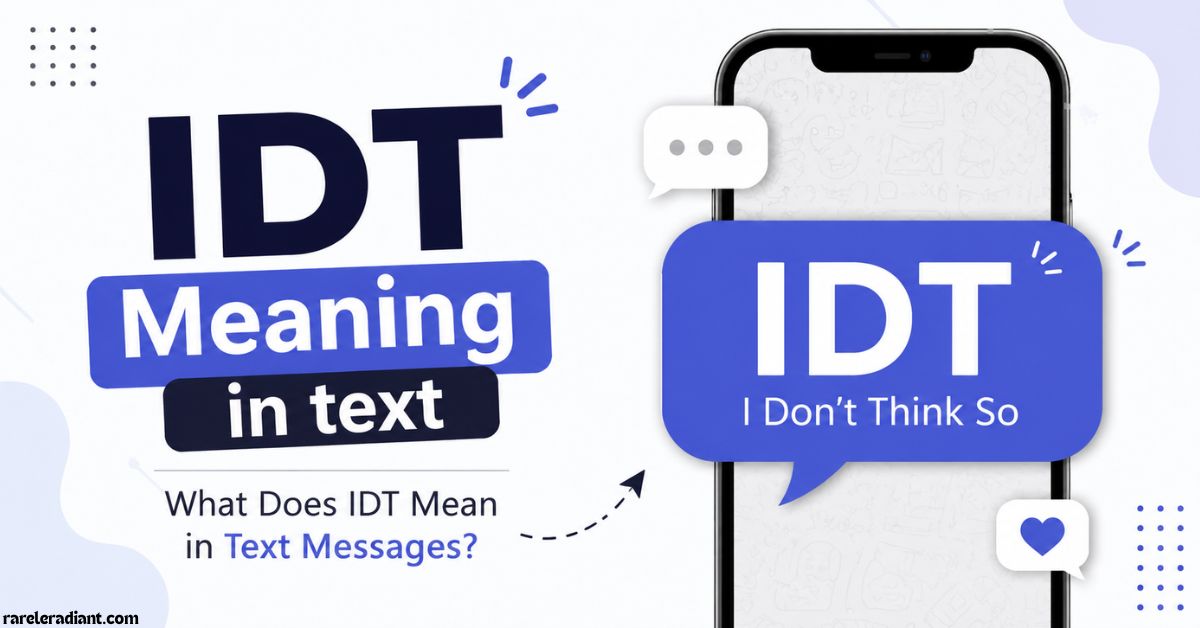
The IDT meaning in text is “I Don’t Think.” People use this abbreviation to express doubt, uncertainty, or a personal opinion without typing the entire phrase.
Instead of writing:
I don’t think that’s true.
Many people simply type:
IDT that’s true.
This shortcut saves time while keeping the conversation casual. Since texting often favors speed over perfect grammar, abbreviations like IDT have become common across messaging apps and social media.
Unlike some internet slang that disappears after a few months, IDT has remained popular because it’s simple, easy to understand, and fits naturally into everyday conversations.
Quick Definition
| Term | Meaning |
|---|---|
| IDT | I Don’t Think |
| Category | Texting abbreviation |
| Tone | Casual, neutral, conversational |
| Common Platforms | SMS, WhatsApp, Snapchat, Instagram, TikTok, Discord |
IDT Full Form in Chat
If you’ve searched for idt full form in chat, the answer is simple:
IDT = I Don’t Think
People use it when they want to share an opinion without sounding overly confident or argumentative.
For example:
Friend: Do you think it’ll rain today?
You: IDT. The forecast looks clear.
Here, “IDT” doesn’t mean you’re completely certain. Instead, it politely suggests that you believe something probably isn’t true.
Why People Prefer IDT
Typing “I don’t think” takes more effort than typing “IDT.” While the difference is only a few characters, those seconds add up during fast conversations.
Here are a few reasons people use it:
- It saves time.
- It feels natural in casual chats.
- Most frequent texters already recognize it.
- It keeps conversations moving quickly.
- It matches other popular abbreviations like IDK, IMO, and TBH.
Think of IDT as conversational shorthand. It delivers the same message with fewer keystrokes.
What Does IDTS Mean in Texting?
While IDT is common, you may also see IDTS in messages.
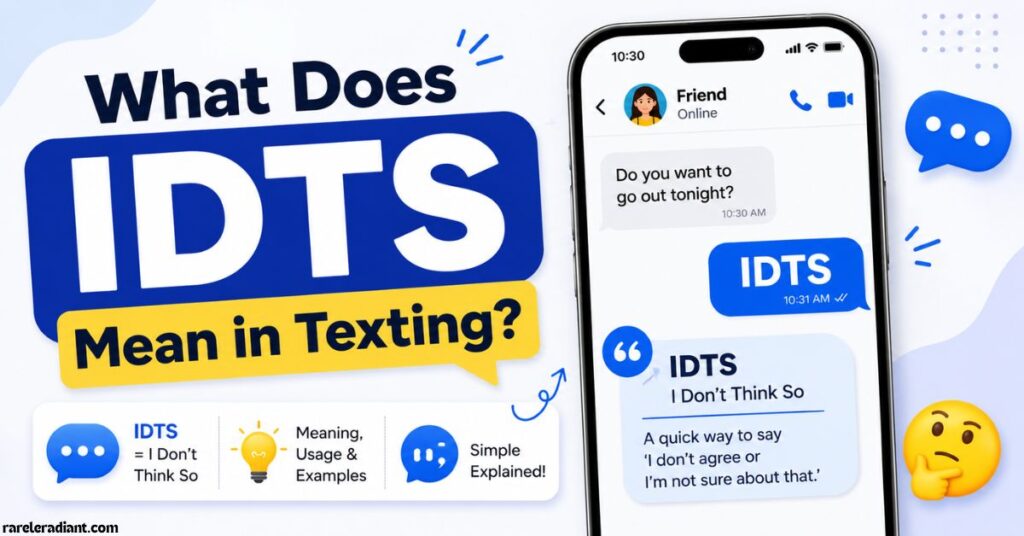
The idts full form is:
I Don’t Think So
Although the two abbreviations look similar, they aren’t interchangeable in every situation.
Adding the word “so” makes the response more complete. That’s why people often use IDTS to answer yes-or-no questions.
Simple Examples
Question: Are they coming tonight?
Reply: IDTS.
Question: Will the meeting end early?
Reply: IDTS, but we’ll see.
Question: Is the game canceled?
Reply: IDTS because the weather looks fine.
In each example, the speaker politely expresses doubt without giving a harsh “No.”
IDT vs. IDTS: What’s the Difference?
At first glance, these abbreviations seem identical. However, they serve slightly different purposes.
| Feature | IDT | IDTS |
|---|---|---|
| Full Form | I Don’t Think | I Don’t Think So |
| Main Purpose | Share an opinion | Answer a yes-or-no question |
| Tone | Thoughtful and open | Slightly firmer but still polite |
| Best Used For | Statements | Direct replies |
| Example | IDT that’s correct. | IDTS we’ll finish today. |
A simple way to remember the difference is this:
- IDT usually starts an opinion.
- IDTS usually finishes an answer.
Example Comparison
Person A: That movie deserved an Oscar.
Person B: IDT. The story was weak.
Person A: Did they win the championship?
Person B: IDTS.
Notice how each abbreviation fits a different type of response.
How People Use IDT in Everyday Conversations
The IDT meaning in text goes beyond its literal definition. People use it to soften opinions, avoid conflict, and express uncertainty in a friendly way.
Let’s explore the most common situations where you’ll encounter it.
Expressing Doubt
One of the biggest reasons people use IDT is to show uncertainty.
Instead of making an absolute statement, they leave room for discussion.
Example:
IDT that’s the right address.
This sounds much gentler than saying:
That’s the wrong address.
The difference may seem small, yet it creates a more respectful conversation.
Sharing a Personal Opinion
IDT often introduces an opinion rather than a fact.
For example:
- IDT pineapple belongs on pizza.
- IDT this update improved the app.
- IDT the ending was satisfying.
Each sentence communicates a personal viewpoint instead of presenting something as universally true.
Politely Disagreeing
Direct disagreement can sound harsh over text because facial expressions and tone are missing.
Adding IDT makes the response feel softer.
Instead of writing:
You’re wrong.
Someone might write:
IDT that’s correct.
That subtle difference helps conversations stay friendly.
Responding Without Sounding Rude
Many people avoid blunt answers online.
Imagine someone asks:
Was my presentation boring?
A harsh response would be:
Yes.
A softer reply might be:
IDT it was boring. I think people were paying attention.
This approach feels more supportive while still being honest.
Buying Time Before Giving a Final Answer
Sometimes people simply aren’t certain.
Rather than committing immediately, they use IDT to signal hesitation.
For example:
IDT we’ll finish today, but let’s keep working.
This tells the other person that your opinion could change if new information appears.
Real Text Message Examples Using IDT
Seeing abbreviations in context makes them much easier to understand.
Here are realistic conversations you’ll encounter in everyday messaging.
Friends Chatting
Alex: Want to order pizza?
Jordan: IDT I’m hungry yet. Maybe later.
Family Conversation
Mom: Is your brother home?
You: IDT. His car isn’t outside.
Dating Conversation
Taylor: Do you think this restaurant is too expensive?
Sam: IDT. The prices seem reasonable.
Gaming Chat
Player 1: Can we beat this boss with our current gear?
Player 2: IDT. We need better equipment first.
Group Chat
Emma: Should we leave at 6 PM?
Noah: IDT traffic will be that bad. We can leave at 6:30.
Social Media Comment
User 1: This is the best phone ever made.
User 2: IDT. There are better options now.
These conversations highlight why IDT feels natural. It expresses disagreement without making the conversation feel confrontational.
Why People Prefer Using IDT Instead of “I Don’t Think”
Language always adapts to the way people communicate. Text messaging favors speed, convenience, and simplicity, which explains why abbreviations continue to thrive.
Here are the biggest reasons IDT remains popular.
It Saves Time
Typing four letters is quicker than typing three separate words.
That might not sound significant, yet it matters during rapid conversations.
It Feels Natural Online
People often mirror the communication style of those around them.
If everyone in a group chat uses abbreviations, you’ll probably do the same without even noticing.
It Keeps Conversations Moving
Imagine a fast-paced gaming session or an active group chat.
Short replies like:
- IDT
- IDK
- IMO
- TBH
allow everyone to respond almost instantly.
That speed keeps discussions flowing without long pauses.
It Matches Modern Internet Culture
Social media platforms encourage concise communication.
Character limits, quick replies, and fast scrolling all reward shorter messages. As a result, abbreviations like IDT have become part of everyday digital language rather than temporary internet trends.
What Does IDT Mean on Different Platforms?
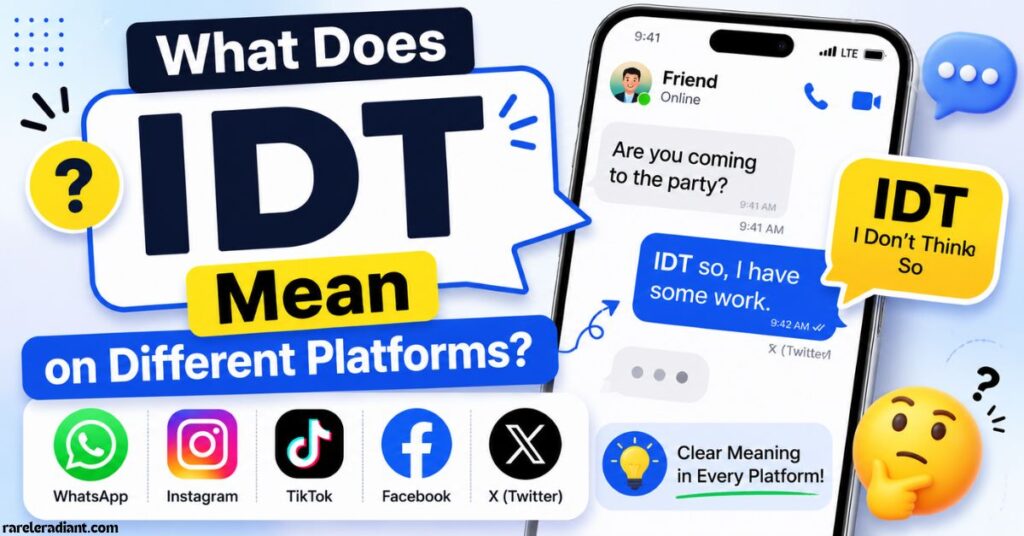
The IDT meaning in text stays the same across most platforms. It still means “I Don’t Think.” However, the way people use it can vary depending on where the conversation happens.
For example, a quick reply on Snapchat feels different from a discussion in a workplace chat. Understanding the context helps you interpret the abbreviation correctly.
SMS and iMessage
Traditional text messages are where abbreviations like IDT became popular.
Friends and family often use it in everyday conversations because it’s short and easy to type.
Examples:
Friend: Are you coming tonight?
You: IDT I’ll make it before 8.
Mom: Did you leave your jacket here?
You: IDT so. I’ll check my room.
Here, IDT keeps the conversation casual without sounding abrupt.
Snapchat
Snapchat conversations usually move fast. Users often rely on abbreviations because messages disappear and replies tend to be brief.
Example:
Friend: Was that your cousin?
You: IDT 😂
The emoji softens the reply and makes it feel more playful.
You’ll often find IDT in comments and direct messages.
People use it when sharing opinions about photos, videos, or trending topics.
Example Comment:
IDT that’s the best outfit from the collection, but it’s still nice.
The abbreviation lets users disagree without appearing overly negative.
TikTok
TikTok comment sections are filled with quick reactions.
Instead of writing long explanations, users often reply with short phrases.
Examples:
- IDT that’s real.
- IDT this challenge is easy.
- IDT anyone expected that ending.
If you’re wondering about the IDT meaning on TikTok, it doesn’t have a special definition. It simply stands for “I Don’t Think.”
Discord
Gaming communities and hobby groups frequently use abbreviations.
During fast-paced conversations, players don’t want to stop and type complete sentences.
Example:
Player 1: Can we defeat the boss now?
Player 2: IDT. We need another healer.
Clear and concise communication matters during multiplayer games, which makes IDT especially useful.
WhatsApp combines casual conversations with family chats, school groups, and work discussions.
IDT appears mostly in personal conversations rather than formal ones.
Example:
Friend: Do you think the movie starts at 7?
You: IDT. I think it’s 7:30.
Facebook Messenger
Messenger conversations tend to mirror normal texting.
You’ll often see IDT used while discussing events, plans, or everyday opinions.
Example:
IDT everyone has confirmed yet.
X (Formerly Twitter)
Because posts are short, abbreviations naturally fit the platform.
Users often include IDT when responding to trending news or sharing opinions.
Example:
IDT that’s the whole story. There’s probably more to it.
Is IDT Rude?
One of the most common questions people ask is whether IDT sounds rude.
The short answer is:
Usually, no.
Most of the time, it’s simply a polite way to express uncertainty or disagreement. Still, tone depends heavily on context.
When It Sounds Neutral
Most conversations fall into this category.
Example:
IDT the store is open yet.
There’s nothing offensive about this statement. It’s simply an opinion.
When It Sounds Polite
IDT often softens disagreement.
Compare these two responses.
Direct Reply
You’re wrong.
Softer Reply
IDT that’s correct.
The second version feels much friendlier.
When It Can Feel Dismissive
Even harmless abbreviations can sound cold if they’re too brief.
Imagine this exchange.
Alex: Did you like my presentation?
Taylor: IDT.
Without any explanation, the reply feels abrupt.
Adding a few extra words changes everything.
IDT, but I liked your introduction.
Now the response feels thoughtful instead of dismissive.
Read Also: Outline Meaning in Art: Why It Matters in Drawing and Design (2026)
How Emojis and Punctuation Change the Tone
Tiny details make a big difference.
| Message | Perceived Tone |
|---|---|
| IDT. | Neutral |
| IDT 😂 | Playful |
| IDT lol | Casual |
| IDT 😊 | Friendly |
| IDT… | Hesitant |
| IDT!! | Strong disagreement |
A simple emoji can completely change how your message is interpreted.
When You Should Avoid Using IDT
Although IDT works well in casual conversations, some situations call for complete sentences.
Professional Emails
Business communication should prioritize clarity.
Instead of writing:
IDT this proposal works.
Write:
I don’t think this proposal addresses the client’s requirements.
The second version sounds more professional and leaves less room for misunderstanding.
Job Applications
Recruiters expect polished communication.
Avoid internet abbreviations in resumes, cover letters, and interview emails.
Business Conversations
Clients and colleagues may not recognize texting slang.
Clear writing builds trust and avoids confusion.
Academic Writing
Essays, research papers, and reports require formal language.
Even if your professor understands IDT, it’s not appropriate in academic work.
Serious Conversations
Sensitive topics deserve thoughtful responses.
Imagine someone sharing difficult news.
A reply like:
IDT.
could seem uncaring.
Writing complete sentences shows empathy.
Common Mistakes People Make About IDT
Despite its simplicity, many people misunderstand this abbreviation.
Let’s clear up the biggest misconceptions.
Confusing IDT with IDK
These abbreviations look similar but have different meanings.
| Abbreviation | Meaning |
|---|---|
| IDT | I Don’t Think |
| IDK | I Don’t Know |
Consider these examples.
Question: Is the restaurant open?
IDK
I have no idea.
IDT
I don’t think it is.
One expresses uncertainty due to missing information. The other expresses an opinion.
Assuming It Always Means “No”
Many people treat IDT as a direct rejection.
That’s not always accurate.
For example:
IDT it’ll rain today.
This doesn’t guarantee sunshine.
It simply reflects the speaker’s current opinion.
Thinking It’s Always Rude
Tone depends on the conversation, not the abbreviation itself.
A respectful sentence with IDT often sounds much kinder than a blunt statement written without it.
Believing Only Teenagers Use It
While younger generations helped popularize texting abbreviations, adults use them too.
Parents, coworkers, gamers, and even grandparents who text regularly may use IDT in casual conversations.
Mixing Up IDT and IDTS
Another common mistake involves confusing these similar abbreviations.
The idts meaning is “I Don’t Think So.”
Because of the added word “so,” it usually answers a direct question.
Question
Are they arriving today?
Correct Reply
IDTS.
Meanwhile, IDT works better when introducing an opinion.
IDT they’ll arrive before dinner.
Understanding this small distinction makes your messages sound much more natural.
How to Reply When Someone Says IDT
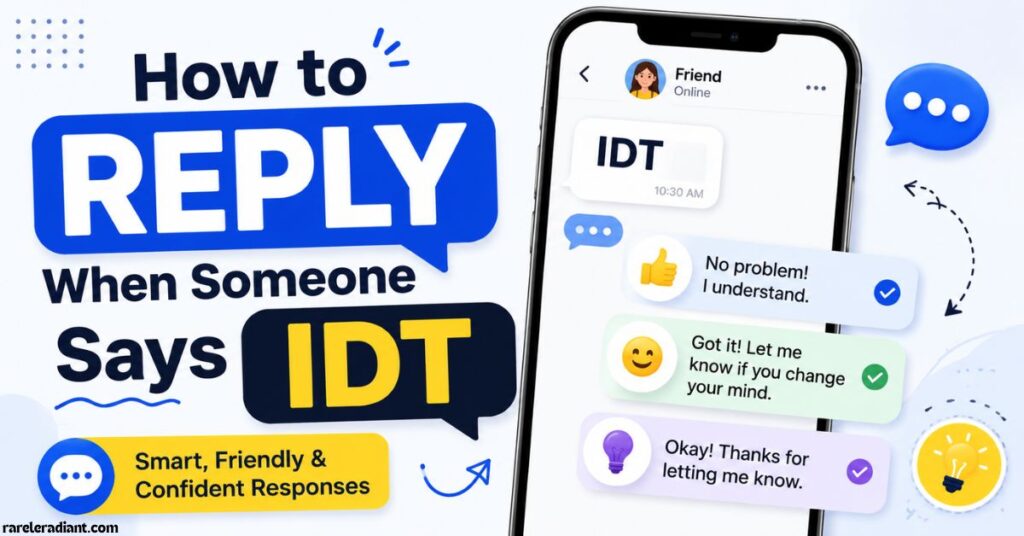
Knowing how to respond keeps conversations flowing smoothly.
If You Agree
You can simply reinforce the opinion.
Examples:
- I agree.
- Same here.
- You’re probably right.
- That’s what I was thinking too.
If You Disagree
Respectful disagreement encourages better conversations.
Examples:
- Maybe, but here’s another perspective.
- I actually think the opposite.
- That’s interesting. I see it differently.
If You Need Clarification
Sometimes IDT isn’t enough.
Ask follow-up questions.
Examples:
- Why do you think that?
- What makes you say that?
- Can you explain your reasoning?
If You’re Joking
Friends often keep the conversation light.
Examples:
- We’ll find out soon 😂
- Challenge accepted!
- Let’s make a bet.
Professional Responses
Even in workplace chats, someone may casually write IDT.
Respond with complete sentences.
Example:
Thanks for your feedback. Could you explain your concerns in more detail?
This keeps the discussion constructive.
Similar Texting Slang to IDT
If you understand IDT, you’ll probably recognize several related abbreviations.
| Abbreviation | Meaning | Example |
|---|---|---|
| IDK | I Don’t Know | IDK where they went. |
| IMO | In My Opinion | IMO this design looks better. |
| IMHO | In My Humble Opinion | IMHO it’s worth trying. |
| TBH | To Be Honest | TBH I expected more. |
| NGL | Not Gonna Lie | NGL that’s impressive. |
| IIRC | If I Remember Correctly | IIRC the meeting starts at 10. |
| SMH | Shaking My Head | SMH that was obvious. |
Learning these abbreviations makes online conversations much easier to follow.
Related Meanings of IDT You Might See
Although this article focuses on the IDT meaning in text, it’s worth knowing that abbreviations sometimes have different meanings in professional fields.
For example, IDT may refer to:
| Industry | Possible Meaning |
|---|---|
| Military | Initial Driver Training |
| Healthcare | Interdisciplinary Team |
| Technology | Integrated Device Technology (company name) |
| Education | Instructional Design and Technology |
Always rely on context before assuming the meaning.
In everyday texting, however, IDT almost always means “I Don’t Think.”
Quick Tips for Using IDT Naturally
Want your messages to sound natural? Keep these tips in mind.
- Use IDT only in casual conversations.
- Match the tone of the person you’re texting.
- Don’t overuse abbreviations.
- Write complete sentences when clarity matters.
- Remember that context determines meaning.
- Choose IDTS when answering yes-or-no questions.
These simple habits make your conversations easier to understand.
Frequently Asked Questions
What does IDT mean in text messages?
IDT stands for “I Don’t Think.” People use it to express doubt, uncertainty, or a personal opinion in casual conversations.
What is the idt full form in chat?
The idt full form in chat is “I Don’t Think.” It’s commonly used in text messages, social media, and online chats to save time while typing.
What does IDTS mean in texting?
The idts full form is “I Don’t Think So.” It usually answers yes-or-no questions politely.
What is the idts meaning in chat?
The idts meaning in chat is “I Don’t Think So.” People use it when they want to disagree gently or indicate that something is probably not true.
Is IDT the same as IDK?
No. IDT means “I Don’t Think,” while IDK means “I Don’t Know.” One expresses an opinion, and the other expresses uncertainty due to a lack of information.
Is IDT considered rude?
Not usually. It generally sounds neutral or polite. However, very short replies without context may come across as dismissive.
What does IDT mean on Snapchat or TikTok?
On Snapchat, TikTok, Instagram, Discord, WhatsApp, and most other platforms, IDT has the same meaning: “I Don’t Think.”
Can adults use IDT?
Absolutely. Although younger users helped popularize texting abbreviations, people of all ages use IDT in casual digital conversations.
Is IDT appropriate for work conversations?
It’s best to avoid IDT in formal emails and professional documents. Complete sentences provide better clarity and create a more professional impression.
When should I use IDT instead of IDTS?
Use IDT when expressing an opinion, such as “IDT that’s correct.” Use IDTS when answering a yes-or-no question, such as “IDTS we’ll finish today.”
Final Thoughts on IDT meaning in chat
The IDT meaning in text is simple, yet understanding how people actually use it makes online conversations much easier to follow. IDT stands for “I Don’t Think,” while IDTS means “I Don’t Think So.” Although they look nearly identical, each serves a slightly different purpose.
Whether you’re texting friends, chatting on Discord, commenting on TikTok, or messaging on WhatsApp, these abbreviations help you express opinions quickly without sounding overly direct. The key is to use them in the right context. Casual conversations welcome abbreviations, while professional communication benefits from complete sentences.
As digital language continues to evolve, learning common abbreviations like IDT, IDK, TBH, and IMO helps you communicate more naturally and understand others with ease. Once you know the difference between IDT and IDTS, you’ll recognize them instantly and use them confidently in your own conversations.

Ilona Leijer is a seasoned content creator with over 4 years of experience specializing in witty puns, clever jokes, wordplay and engaging humor. His creative work is the driving force behind Rarele Radiant , a platform dedicated to bringing laughter, creativity, and memorable content to readers around the world.