

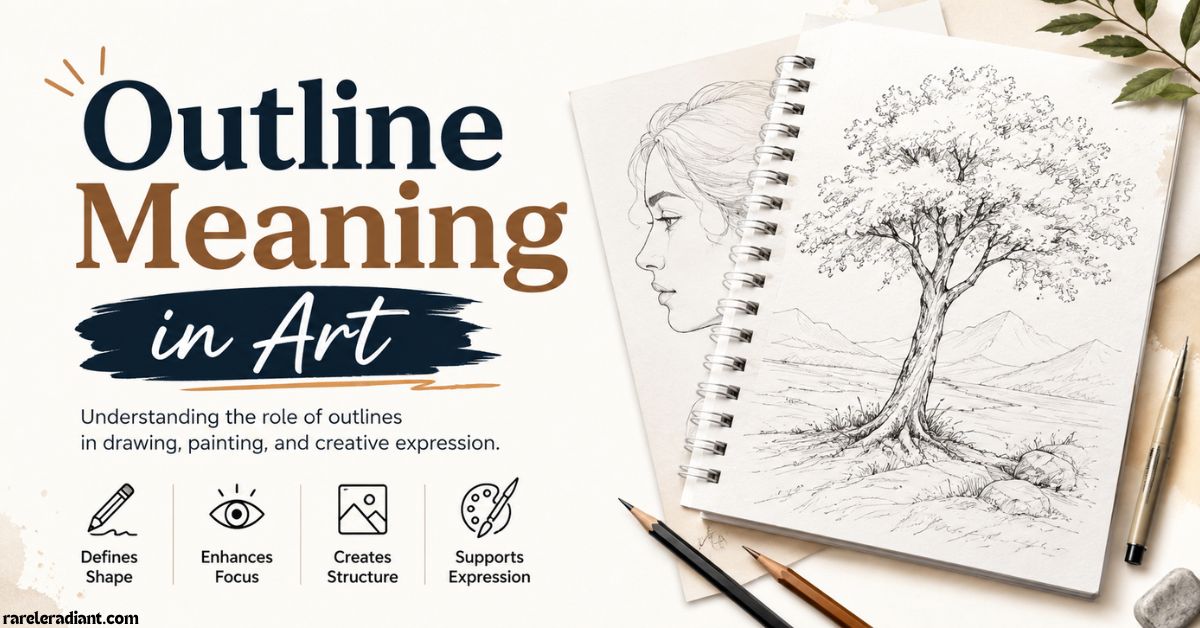
Understanding the outline meaning in art is one of the first steps toward becoming a better artist. Whether you’re sketching with a pencil, painting on canvas, or creating digital illustrations, outlines help you organize your ideas and communicate them clearly.
They simplify complex subjects into recognizable forms, making drawings easier to understand and more visually appealing.
In this guide, you’ll learn the outline definition in art, explore why outlines matter, discover the different types of outlines, and see how professional artists use them across various creative fields.
By the end, you’ll have a solid understanding of why this seemingly simple technique remains one of the strongest foundations in drawing and design.
What Does Outline Mean in Art?
The outline meaning in art refers to the visible line that defines the outer edge or boundary of a subject. It separates an object from the surrounding space and gives it a clear, recognizable shape.
In simple terms, an outline tells your eyes, “This is where the object begins and ends.”
Unlike shading or texture, an outline doesn’t attempt to show every surface detail. Instead, it captures the overall form, allowing viewers to recognize the subject almost instantly.
Outline Definition in Art
The outline definition in art is:
An outline is a line or series of lines that marks the outer boundary of a subject, defining its shape while separating it from the surrounding space.
This definition of outline in art applies across nearly every visual discipline, including drawing, painting, illustration, graphic design, animation, architecture, and digital art.
Why Are Outlines So Important?
Imagine looking at a coloring book before it’s colored. Even without color, shadows, or highlights, you can immediately identify the objects because the outlines define every shape.
Outlines help artists:
- Build accurate proportions.
- Simplify complex objects.
- Plan compositions before adding details.
- Separate foreground and background elements.
- Create recognizable forms with minimal information.
Without outlines, many drawings would appear confusing or unfinished.
Everyday Examples of Outlines
You encounter outlines more often than you might realize.
| Example | How Outline Is Used |
|---|---|
| Coloring books | Defines spaces for coloring |
| Logos | Creates simple, memorable shapes |
| Road signs | Makes symbols easy to recognize |
| Cartoons | Separates characters from backgrounds |
| Icons | Uses minimal lines for instant recognition |
| Fashion sketches | Establishes clothing silhouettes |
These examples show why outlines remain one of the most effective visual communication tools.
Why Outlines Matter in Drawing and Design
Every successful artwork begins with a clear structure. That structure usually starts with an outline.
Professional artists rarely jump straight into shading or painting. Instead, they first establish the subject’s proportions using light construction lines and clean outlines. This approach reduces mistakes and creates a strong visual foundation.
They Create Instant Recognition
Our brains process shapes before they notice details.
For example, you can recognize the outline of a bicycle even if it contains no color or shading. The human visual system identifies familiar silhouettes remarkably quickly.
That’s why many famous logos remain recognizable even in a single color.
They Simplify Complex Subjects
A tree contains thousands of leaves.
A portrait contains countless facial details.
Yet artists begin with simple outlines because breaking complex forms into manageable shapes makes drawing easier.
Instead of drawing every leaf, an artist first outlines the tree’s overall silhouette.
They Improve Composition
Outlines help artists arrange objects before committing to final details.
This planning stage allows artists to:
- Balance positive and negative space.
- Position focal points.
- Avoid awkward overlaps.
- Maintain accurate proportions.
Good composition almost always begins with good outlines.
They Support Every Artistic Style
Whether you enjoy realism or abstract art, outlines play an important role.
Different styles simply use them differently.
| Art Style | Role of Outlines |
|---|---|
| Realism | Light planning guides before shading |
| Comics | Bold outlines define characters |
| Manga | Dynamic line work adds energy |
| Minimalism | Outlines become the artwork itself |
| Vector Art | Clean paths create scalable graphics |
| Technical Drawing | Precise outlines ensure accuracy |
The Science Behind Why Humans Recognize Outlines So Quickly
Outlines aren’t just an artistic convention. They’re deeply connected to how the human brain processes visual information.
Before your brain identifies colors or textures, it detects edges.
Scientists call this process edge detection, and it’s one of the earliest stages of visual perception.
When light changes sharply between two surfaces, your eyes detect that boundary almost instantly.
Those boundaries become outlines.
Your Brain Prefers Shapes First
Think about recognizing a cat at night.
You probably notice its silhouette before seeing its fur pattern.
That’s because your brain identifies overall shapes first and fine details second.
Artists take advantage of this natural process by creating strong outlines that communicate form immediately.
Why Children Learn Through Outlines
Children’s books often use bold outlines because young learners recognize simple shapes faster than complex textures.
This same principle explains why coloring books remain one of the earliest art activities children experience.
Simple outlines encourage observation without overwhelming beginners.
Minimalism Works for the Same Reason
Many modern logos contain very little detail.
Despite that simplicity, they’re instantly recognizable.
Strong outlines remove unnecessary information while preserving the subject’s identity.
That’s visual efficiency at work.
Outline as One of the Fundamental Elements of Art
Every artwork relies on several core elements.
These include:
- Line
- Shape
- Form
- Color
- Texture
- Value
- Space
Although outline isn’t officially listed as a separate element, it grows directly from the element of line.
An outline transforms individual lines into recognizable shapes.
How Outline Connects with Other Elements
| Element | Relationship with Outline |
|---|---|
| Line | Creates the outline itself |
| Shape | Defined by the outline |
| Form | Suggests three-dimensional structure |
| Space | Separates positive and negative areas |
| Texture | Added after outlines establish boundaries |
| Value | Uses light and dark inside outlines |
| Color | Usually applied within outlined areas |
Every one of these elements builds upon a well-planned outline.
Why Art Teachers Start with Outlines
Most beginner drawing classes begin with contour and outline exercises.
There’s a simple reason.
If proportions are incorrect, no amount of beautiful shading can fix the drawing.
Strong outlines establish accuracy before details enter the picture.
As the famous artist Paul Cézanne once said:
“Treat nature by means of the cylinder, the sphere, and the cone.”
His advice encourages artists to simplify complex forms before adding detail, and outlines make that possible.
Different Types of Outlines in Art
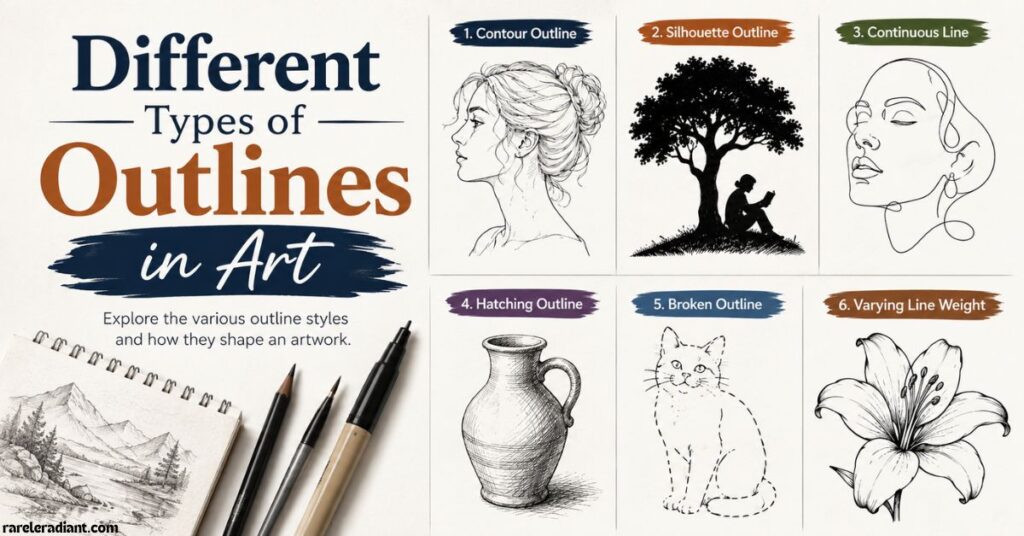
Not every outline serves the same purpose.
Different artistic situations require different kinds of outlines.
Understanding each type helps artists choose the right technique for the subject.
Contour Outline
A contour outline follows the visible edges of a subject.
Rather than focusing on tiny details, it captures the object’s overall shape.
Artists commonly use contour outlines for:
- Portraits
- Still life
- Animals
- Botanical studies
Contour drawing improves observation because it forces artists to study edges carefully.
Continuous Outline
A continuous outline uses one uninterrupted line.
The artist keeps the drawing tool on the paper from start to finish.
This exercise develops:
- Hand control
- Observation skills
- Drawing confidence
- Eye-hand coordination
Although the finished drawing may appear simple, continuous line drawing strengthens fundamental skills.
Blind Contour Drawing
Blind contour drawing takes the challenge one step further.
Instead of looking at the paper, artists focus entirely on the subject while drawing.
The result often looks distorted.
That’s perfectly normal.
The goal isn’t perfection.
The goal is learning to truly observe rather than relying on assumptions.
Many art schools use blind contour exercises during the first weeks of instruction because they improve visual awareness dramatically.
Broken Outline
Sometimes artists intentionally leave gaps.
These incomplete edges create what’s called a broken outline.
Instead of describing every boundary, the viewer’s brain fills in the missing information.
Broken outlines help:
- Suggest light
- Create atmosphere
- Reduce visual clutter
- Produce softer transitions
Watercolor artists frequently use this technique because harsh outlines can overpower delicate washes.
Sketch Outline
Sketch outlines are loose planning lines.
They’re not meant to remain in the finished artwork.
Instead, they allow artists to:
- Explore ideas quickly.
- Adjust proportions.
- Test different poses.
- Refine compositions.
Professional illustrators often produce several sketch outlines before committing to a final drawing.
Gesture or Expressive Outline
Gesture outlines capture movement rather than precise detail.
They’re quick.
They’re energetic.
Most gesture drawings take between 30 seconds and two minutes.
Animators and character designers rely heavily on gesture outlines because movement communicates personality more effectively than perfect accuracy.
Geometric Outline
Some subjects depend on precision.
Architecture.
Engineering.
Product design.
These fields use geometric outlines built from circles, rectangles, triangles, and measured lines.
Unlike expressive sketches, geometric outlines prioritize accuracy over emotion.
Silhouette Outline
A silhouette is the purest form of an outline.
It shows only the subject’s outer edge.
- Noo internal details.
2. No textures.
3. No shading.
Strong silhouettes remain recognizable from a distance, which explains why they’re widely used in:
- Logo design
- Character creation
- Branding
- Traffic symbols
- Mobile app icons
Designers often test silhouettes first because if the outline communicates clearly, the finished design usually succeeds.
Outline vs. Contour vs. Line: Understanding the Differences
Many beginners use these terms interchangeably.
While they’re closely related, they don’t mean the same thing.
Understanding the distinction will improve both your drawing vocabulary and your artistic skills.
| Term | Definition | Primary Purpose |
|---|---|---|
| Line | A mark that connects two points or creates direction. | Builds structure, texture, movement, and detail. |
| Outline | The outer boundary that defines a subject’s overall shape. | Separates the object from surrounding space. |
| Contour | A line that follows the visible edges or surface changes of a subject. | Describes both the outer shape and internal form. |
Outline vs. Contour
An outline only traces the outside edge of an object.
A contour goes further by describing curves, folds, and surface transitions within the subject.
For example, when drawing a face:
- The outline defines the head’s outer shape.
- Contour lines describe the nose, cheeks, lips, and eye sockets.
In other words, every outline is a line, but not every line is an outline. Likewise, contour lines often include much more information than a simple outline.
Understanding these differences helps you use the correct technique for the effect you want to achieve.
How Line Weight Changes the Power of an Outline
A simple outline can describe an object. A well-controlled outline can make that object feel alive.
This is where line weight becomes essential. Line weight refers to the thickness or thinness of a line. Professional artists rarely draw every outline with the same pressure because variation creates depth, focus, and realism.
Think of line weight as the visual equivalent of speaking. If every word had the same tone and volume, the conversation would sound flat. Drawing works the same way. Changing the thickness of your lines adds emphasis and rhythm.
What Is Line Weight?
Line weight is the variation in line thickness throughout a drawing.
Artists adjust line weight by changing pressure, switching tools, or selecting different brush sizes in digital software.
Why Line Weight Matters
Using different line weights helps you:
- Create the illusion of depth.
- Separate foreground objects from the background.
- Suggest light and shadow.
- Make important features stand out.
- Add movement and energy.
- Improve readability.
For example, comic artists often use thick outer outlines to separate characters from the background. Inside the character, they use thinner lines for facial features and clothing details.
How to Practice Better Line Weight
A simple exercise can improve your control.
- Draw a basic circle.
- Make the bottom half thicker.
- Keep the top half thin.
- Repeat using different objects.
Over time, your hand naturally develops better pressure control.
“The line is the most basic tool of the artist. Master it, and everything else becomes easier.”
Outline Techniques Used Across Different Art Styles
Every art style approaches outlines differently. Some rely on bold edges, while others barely use visible outlines at all.
Understanding these differences helps you adapt your drawing style without losing solid fundamentals.
Realism
Realistic artists often begin with light outlines before gradually replacing them with values and shading.
The final artwork may contain almost no visible outlines because changes in light define the subject instead.
Cartoon Art
Cartoons depend heavily on bold outlines.
Clear edges improve readability, exaggerate expressions, and make characters recognizable even from a distance.
Comics and Manga
Comic artists use expressive outlines to control storytelling.
They vary line thickness to:
- Show depth.
- Emphasize action.
- Separate characters.
- Direct the reader’s eye.
Anime
Anime combines clean outlines with controlled line variation.
Characters usually have smooth facial outlines while hair and clothing contain more dynamic strokes.
Minimalist Illustration
Minimalist artists remove unnecessary detail.
Often, a single continuous outline communicates an entire subject.
Graphic Design
Graphic designers use outlines when creating icons, logos, and illustrations.
The goal is clarity rather than realism.
Tattoo Design
Tattoo artists rely on crisp outlines because those lines determine how well the tattoo ages over time.
A strong outline helps preserve the design for years.
Technical Drawing
Architectural and engineering drawings demand precise outlines.
Every line represents measurable information, leaving little room for artistic interpretation.
How Different Art Mediums Use Outlines
Although the concept remains the same, different mediums require different outlining techniques.
| Medium | How Outlines Are Used |
|---|---|
| Pencil | Light sketches before shading |
| Ink | Permanent, clean outlines |
| Charcoal | Soft, expressive outlines |
| Colored Pencil | Layered outlines with subtle transitions |
| Watercolor | Often uses minimal or broken outlines |
| Acrylic | Can include bold or hidden outlines |
| Oil Painting | Usually covered during later stages |
| Digital Art | Adjustable vector or raster outlines |
| Printmaking | Essential for carving and printing |
Pencil Drawing
Pencils allow artists to erase and refine outlines easily.
Most professional drawings begin with very light construction lines.
Ink and Pen
Ink demands confidence.
Because ink cannot easily be erased, artists usually complete a pencil sketch first.
Charcoal
Charcoal creates expressive, soft edges.
Artists often smudge charcoal outlines to create atmosphere.
Watercolor
Many watercolor painters avoid harsh outlines because they compete with transparent color washes.
Instead, they rely on implied edges.
Digital Illustration
Digital artists can adjust outlines at any stage.
Modern software also allows:
- Pressure-sensitive brushes.
- Stabilized strokes.
- Editable layers.
- Infinite revisions.
Vector Graphics
Unlike raster images, vector outlines remain perfectly sharp regardless of size.
That’s why logos are almost always created as vectors.
Essential Tools for Creating Clean Outlines
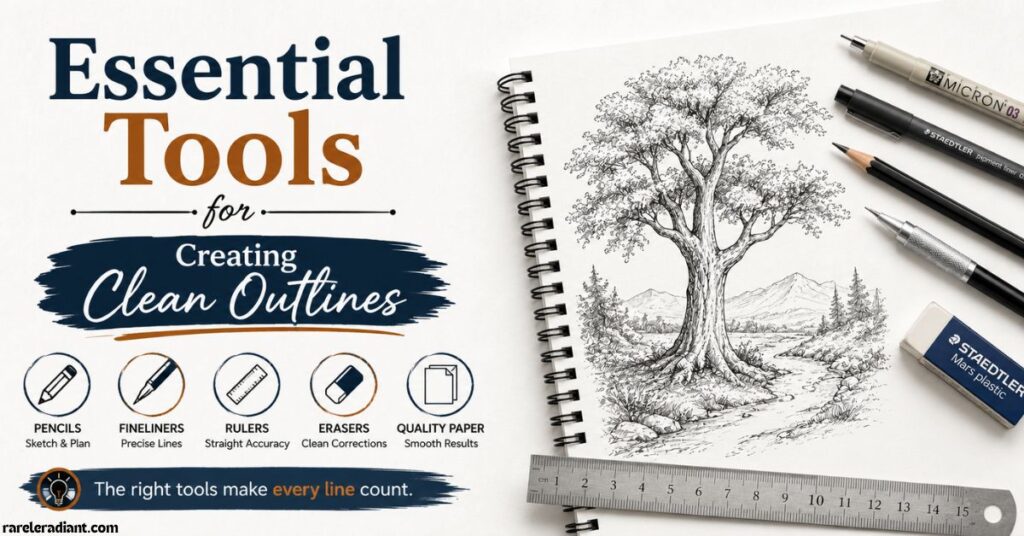
The best tool depends on your artistic goals.
Traditional Drawing Tools
- Graphite pencils (HB to 6B)
- Mechanical pencils
- Fineliners
- Technical pens
- Brush pens
- India ink
- Charcoal
- Erasers
- Blending stumps
Digital Tools
- Drawing tablet
- Pressure-sensitive stylus
- iPad with Apple Pencil
- Professional illustration software
Beginner Recommendation
If you’re just starting, you don’t need expensive supplies.
A quality HB pencil, sketchbook, kneaded eraser, and fineliner are enough to learn excellent outlining skills.
Remember, skill grows from practice rather than expensive equipment.
Outline Techniques Professional Artists Use
Professionals rarely begin with detailed outlines.
Instead, they build drawings step by step.
Blocking In Shapes
Artists first reduce complex subjects into basic forms like:
- Circles
- Squares
- Triangles
- Cylinders
- Cubes
This simplifies proportions before details appear.
Drawing Negative Space
Instead of drawing the object itself, artists sometimes draw the empty space surrounding it.
This technique reveals proportion mistakes surprisingly quickly.
Cross-Checking Proportions
Professional artists constantly compare:
- Width versus height.
- Angles.
- Distances.
- Alignment.
This prevents small errors from becoming major problems later.
Using Construction Lines
Construction lines act as invisible guides.
Once the final outline feels accurate, these guides disappear.
Nearly every experienced illustrator uses them.
Refining the Final Outline
Only after proportions look correct do artists strengthen the final outline.
This keeps the drawing clean while reducing unnecessary corrections.
Common Outline Mistakes Beginners Make
Learning what not to do often improves your drawing faster than learning new techniques.
Drawing Every Line with Equal Thickness
Uniform outlines make drawings look flat.
Instead, vary your line weight to create depth.
Pressing Too Hard Too Early
Heavy early lines become difficult to erase.
Professional artists sketch lightly until they’re confident.
Chasing Tiny Details First
Many beginners start with eyes, hair, or clothing before establishing the overall shape.
That often leads to incorrect proportions.
Always build the larger outline first.
Ignoring Perspective
Even a perfect outline looks wrong if perspective is inconsistent.
Practice drawing simple boxes and cylinders before moving to complex subjects.
Tracing Too Often
Tracing can help you study shapes occasionally.
However, relying on it prevents you from developing observation skills.
Forgetting Implied Lines
Not every edge needs a visible outline.
Sometimes leaving a small gap creates a more natural and elegant drawing.
Practical Exercises to Improve Your Outline Skills
Consistent practice matters more than talent.
These exercises strengthen observation and hand control.
One-Line Drawing
Draw an object without lifting your pencil.
This improves confidence and fluid movement.
Blind Contour Exercise
Look only at the subject.
Never look at your paper.
Although the drawing may appear distorted, your observation skills will improve dramatically.
Gesture Drawing
Set a timer for 30 to 90 seconds.
Capture movement rather than details.
Gesture drawing teaches speed and visual decision-making.
Negative Space Practice
Instead of outlining the object, draw the empty shapes around it.
This trains your eyes to see accurate proportions.
Daily Object Sketching
Draw one everyday object each day.
Examples include:
- Coffee mugs
- Shoes
- Plants
- Books
- Keys
- Chairs
Even fifteen minutes of daily practice produces noticeable improvement over time.
Real-World Uses of Outline in Creative Industries
Outlines extend far beyond traditional drawing.
Nearly every visual industry depends on them.
Illustration
Illustrators establish clean outlines before adding color and texture.
Graphic Design
Icons, branding, and logos rely on strong outlines for instant recognition.
Animation
Animators create thousands of outlined frames that bring characters to life.
Game Art
Concept artists begin with silhouettes before refining detailed characters.
Strong outlines improve readability during gameplay.
Fashion Illustration
Fashion designers sketch garment outlines to explore proportions and fabric flow.
Architecture
Architectural plans use precise outlines to communicate structural information.
Product Design
Industrial designers outline products before creating three-dimensional models.
UI and Icon Design
Every mobile app icon begins as a simple outlined shape.
Without clear outlines, digital interfaces become confusing.
Famous Artists Known for Their Use of Outlines
Several influential artists transformed the way outlines are used.
| Artist | Contribution |
|---|---|
| Pablo Picasso | Simplified subjects into expressive outlines. |
| Henri Matisse | Created elegant line drawings with remarkable simplicity. |
| Keith Haring | Used bold outlines to create instantly recognizable figures. |
| Egon Schiele | Combined expressive outlines with emotional intensity. |
| Aubrey Beardsley | Mastered decorative black-and-white line work. |
Case Study: Henri Matisse’s Line Drawings
Late in his career, Henri Matisse produced a series of minimalist line drawings using only a few continuous strokes.
Despite their simplicity, viewers immediately recognized faces, plants, and human figures.
His work demonstrates an important lesson:
A confident outline often communicates more effectively than excessive detail.
How Beginners Can Learn Outlining Faster
Improvement doesn’t happen overnight.
However, following a structured approach speeds up progress.
Focus on these habits:
- Draw from real life whenever possible.
- Study simple geometric forms first.
- Practice every day, even briefly.
- Observe more than you draw.
- Build confidence before adding details.
- Learn from master drawings.
- Accept imperfect sketches as part of learning.
Remember, every professional artist once struggled with basic outlines.
The difference is that they kept practicing.
Frequently Asked Questions
What is the meaning of outline in art?
The outline meaning in art refers to the line that defines the outer boundary of an object. It separates the subject from the surrounding space and establishes its overall shape.
What is the outline definition art students should know?
The outline definition art students commonly learn is that an outline is a line or series of lines marking the outer edge of a subject. It serves as the structural foundation for drawing and design.
What is the definition of outline in art?
The definition of outline in art is the visible boundary that encloses a subject and communicates its form before details, texture, or shading are added.
Is an outline the same as a contour line?
No. An outline marks the outer edge of an object, while contour lines describe both the outer edge and the internal surfaces or forms.
Should every drawing have outlines?
Not necessarily. Many realistic paintings hide or soften outlines with light and shadow. However, artists usually begin with outlines during the planning stage.
Why do professional artists sometimes avoid visible outlines?
Realistic artists often replace outlines with value changes because objects in nature rarely have dark borders. This approach creates a more lifelike appearance.
What is blind contour drawing?
Blind contour drawing is an exercise where you draw the subject without looking at your paper. It strengthens observation and hand-eye coordination.
Which tools create the cleanest outlines?
Graphite pencils, fineliners, technical pens, and digital styluses all produce clean outlines. The best choice depends on your preferred medium.
Why is line weight important?
Line weight adds depth, emphasis, and visual interest. Varying line thickness makes drawings feel more dynamic and easier to read.
Final Thoughts
Understanding the outline meaning in art gives you a stronger foundation for every creative project. Whether you’re sketching with a pencil, painting on canvas, or designing digital graphics, a thoughtful outline brings structure, clarity, and balance to your work.
The outline definition in art goes far beyond drawing a simple border. It represents the first stage of observation, planning, and visual communication. As you practice, you’ll discover that even the most detailed masterpieces begin with confident, well-placed lines.
Master the basics before chasing complexity. Study shapes carefully, experiment with different outline techniques, and draw consistently. Over time, your outlines will become more accurate, expressive, and purposeful. Those improvements will naturally carry into every other aspect of your artistic journey.

Ilona Leijer is a seasoned content creator with over 4 years of experience specializing in witty puns, clever jokes, wordplay and engaging humor. His creative work is the driving force behind Rarele Radiant , a platform dedicated to bringing laughter, creativity, and memorable content to readers around the world.