

Have you ever wondered why millions of people search for Opel meaning each year? Some want to know whether Opel is simply a car brand, while others are curious about the history behind the name. The answer goes far beyond automobiles.
Opel is one of Germany’s oldest and most influential automotive manufacturers. Before becoming famous for reliable cars, the company built sewing machines and bicycles. Over more than 160 years, Opel transformed from a small family business into a globally recognized automotive brand that helped shape the European car industry.
In this guide, you’ll discover the true Opel meaning, the origin of the name, the remarkable story of founder Adam Opel, and how the company evolved into one of Europe’s best-known automobile manufacturers.
Opel Meaning Explained
The Opel meaning is straightforward. Opel is the surname of the company’s founder, Adam Opel, who established the business in 1862 in Rüsselsheim, Germany. Unlike many modern automotive brands, Opel is not an acronym and does not stand for a phrase or hidden message.
The name became synonymous with quality engineering, innovation, and practical transportation over decades of continuous development.
Today, when people hear the word Opel, they usually think of:
- German automobiles
- European engineering
- Affordable family vehicles
- More than 160 years of industrial history
- A respected automotive legacy
Simply put, Opel meaning refers to a historic German automobile manufacturer named after its founder.
What Does Opel Mean?
At its core, Opel is a family name. It carries the legacy of Adam Opel, an entrepreneur whose business eventually became one of Europe’s largest automobile companies.
Unlike brand names that were invented for marketing purposes, Opel’s identity comes directly from its founder’s surname. That gives the company a strong historical connection and authentic heritage.
Today, the Opel name represents:
| Aspect | Meaning |
|---|---|
| Origin | Founder’s surname |
| Industry | Automotive manufacturing |
| Country | Germany |
| Founded | 1862 |
| Known For | Cars, SUVs, vans, electric vehicles |
The simplicity of the name has helped it remain recognizable across generations.
Is Opel a Word or a Family Name?
Many people assume Opel might be an abbreviation or a German word with a dictionary definition. In reality, it is a German surname.
Because the company became internationally successful, the surname gradually transformed into a globally recognized brand.
This isn’t unusual in the automotive world. Several famous manufacturers also bear the names of their founders, including:
- Ford
- Peugeot
- Ferrari
- Porsche
- Bentley
Opel follows the same tradition, preserving the founder’s family name as the company’s identity.
Why the Name “Opel” Became Globally Recognized
A name alone doesn’t become famous. It earns recognition through innovation, trust, and consistency.
Several factors helped Opel become one of Europe’s most recognized automotive brands.
- More than 160 years of business history
- Millions of vehicles sold worldwide
- Strong reputation for engineering
- Long presence across European markets
- Continuous innovation from mechanical to electric vehicles
Over time, Opel meaning evolved from being simply a surname into a symbol of dependable German manufacturing.
“A great brand tells a story before it sells a product.” Opel’s history is one of the strongest examples of this principle.
The Origin of the Opel Name
Understanding the origin of the Opel name helps explain why it still carries so much weight today.
Unlike brands created by advertising agencies, Opel emerged during Germany’s industrial revolution. The company grew alongside modern manufacturing, eventually becoming a household name across Europe.
The Surname Behind the Brand
The Opel family lived in Germany long before automobiles existed.
When Adam Opel founded his workshop in the nineteenth century, he simply placed his own surname on the products he manufactured. At first, that name appeared on sewing machines rather than automobiles.
Customers associated the Opel name with craftsmanship and reliability long before the company produced its first vehicle.
That reputation became one of the company’s greatest competitive advantages.
Adam Opel and the Birth of the Company
Adam Opel founded his company in 1862 in Rüsselsheim, a town near Frankfurt, Germany.
His first products weren’t cars.
Instead, he manufactured high-quality sewing machines, which quickly gained popularity because of their precision and durability.
The business expanded steadily throughout the late nineteenth century.
After Adam Opel’s death, his wife Sophie Opel and their sons continued growing the company. Their leadership eventually pushed Opel into bicycle production and later into automobile manufacturing.
Without their vision, Opel might never have become an automotive icon.
When and Where Opel Was Founded
The following table highlights the company’s beginnings.
| Detail | Information |
|---|---|
| Founder | Adam Opel |
| Founded | 1862 |
| Original Business | Sewing machines |
| Headquarters | Rüsselsheim am Main, Germany |
| First Industry | Manufacturing |
Rüsselsheim remains Opel’s headquarters today, making it one of the few historic automotive companies still closely tied to its original hometown.
Who Was Adam Opel?
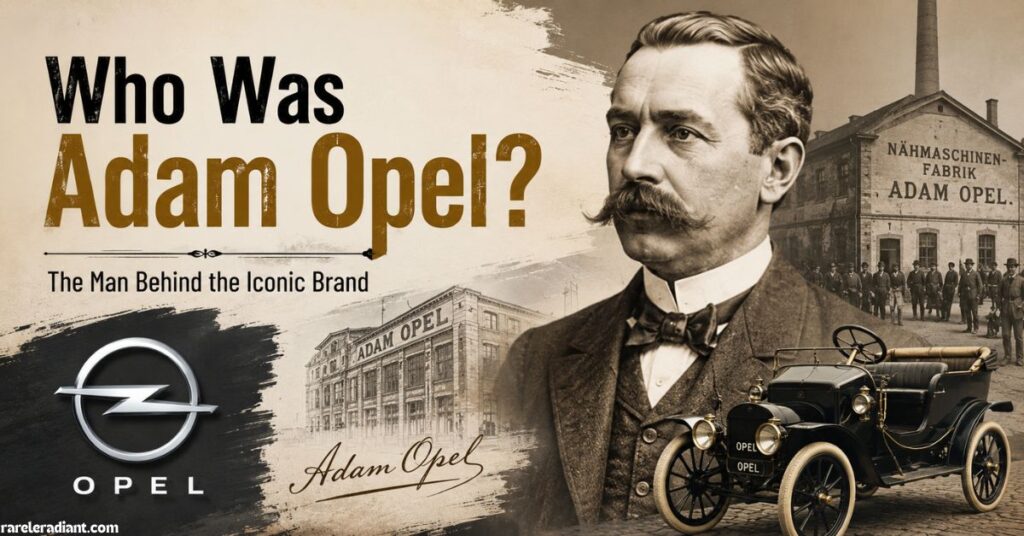
Every legendary company begins with someone willing to solve real problems.
For Opel, that person was Adam Opel.
His entrepreneurial mindset laid the foundation for one of Europe’s most successful industrial businesses.
Early Life and Career
Adam Opel was born on May 9, 1837, in Rüsselsheim, in what was then the Grand Duchy of Hesse.
His father worked as a locksmith, exposing young Adam to metalworking and mechanical craftsmanship from an early age.
Rather than entering business immediately, Adam completed an apprenticeship that taught him precision engineering.
Those technical skills later became essential to his success.
From Locksmith Apprentice to Entrepreneur
As a young craftsman, Adam Opel traveled across Europe to improve his knowledge.
He spent time working in countries including:
- France
- Belgium
- England
These journeys introduced him to advanced manufacturing methods that were uncommon in Germany during that period.
When he returned home, he combined those ideas with his own ambition and established a workshop producing sewing machines.
This decision marked the beginning of the Opel story.
The Vision That Shaped the Opel Brand
Adam Opel believed manufacturing should focus on quality instead of shortcuts.
His business philosophy emphasized:
- Precision engineering
- Reliable products
- Continuous improvement
- Practical innovation
- Customer trust
Those values remained central to Opel long after his death in 1895.
Interestingly, Adam Opel never saw the company become an automobile manufacturer. His family expanded into the automotive industry several years after he passed away.
His legacy, however, guided every major decision that followed.
Is Opel a German Company?
Yes. Opel is unquestionably a German company.
Although ownership has changed several times throughout its history, Opel’s identity remains deeply rooted in Germany.
The company continues designing, engineering, and manufacturing many vehicles within Europe.
Opel’s German Heritage
Germany has produced some of the world’s most respected automobile manufacturers.
Opel stands alongside brands known for engineering excellence because of its long commitment to innovation and manufacturing quality.
Its German heritage is reflected in:
- Engineering standards
- Vehicle safety
- Manufacturing precision
- Industrial innovation
- Research and development
For over a century, Opel has played an important role in Germany’s automotive economy.
Headquarters and Manufacturing Locations
Opel’s global headquarters remains in Rüsselsheim am Main, Germany.
The company also operates or has operated manufacturing facilities across several European countries, including:
| Country | Manufacturing Presence |
|---|---|
| Germany | Major engineering and production |
| Spain | Vehicle assembly |
| Poland | Manufacturing operations |
| Hungary | Engine production |
| United Kingdom* | Historic Vauxhall production partnership |
*Vehicles sold under the Vauxhall brand have historically shared engineering and platforms with Opel models.
This international production network allows Opel to serve customers across Europe efficiently.
Who Owns Opel Today?
While Opel remains proudly German, its ownership has evolved over time.
Today, Opel operates as part of Stellantis, one of the world’s largest automotive groups.
Before joining Stellantis, the company experienced several ownership phases, including:
| Period | Ownership |
|---|---|
| 1862–1929 | Opel family |
| 1929–2017 | General Motors |
| 2017–2021 | Groupe PSA |
| 2021–Present | Stellantis |
Despite these ownership changes, Opel continues preserving its German engineering identity while benefiting from the global resources of a multinational automotive group.
Opel History: From Sewing Machines to Automobiles
Few companies have transformed as dramatically as Opel.
Its journey reflects the changing needs of society during the Industrial Revolution and beyond. What began as a small workshop producing sewing machines eventually became one of Europe’s automotive powerhouses.
The story isn’t just about changing products. It’s about recognizing opportunity, embracing innovation, and adapting to new technologies before competitors did.
In the next section, we’ll explore how Opel evolved from a sewing machine manufacturer into a bicycle giant and finally into one of the world’s most recognized automobile brands.
Opel History: From Sewing Machines to Automobiles
The history of Opel is a remarkable example of how a business can evolve with changing technology and consumer needs. Instead of remaining focused on one product, Opel adapted to each new era. That willingness to innovate helped the company survive economic changes, world wars, and fierce competition.
Today, Opel is known for modern cars and electric vehicles. However, its journey started with a completely different product.
The Sewing Machine Business (1862–1886)
When Adam Opel established his workshop in 1862, sewing machines were becoming essential household and industrial tools across Europe.
After studying manufacturing techniques in France, Adam believed Germany needed reliable, well-built sewing machines. He invested in precision engineering instead of mass-producing inexpensive products.
His strategy worked.
Within a few years, Opel sewing machines earned an excellent reputation for quality and durability. Demand grew steadily, allowing the company to expand its workforce and manufacturing facilities.
Several factors contributed to Opel’s early success.
- Consistent product quality
- Precision manufacturing
- Affordable pricing
- Reliable customer support
- Continuous mechanical improvements
By the 1880s, Opel had become one of Germany’s leading sewing machine manufacturers.
Fun Fact: Before producing a single automobile, Opel had already built thousands of sewing machines that were sold throughout Europe.
Becoming One of Europe’s Largest Bicycle Manufacturers
While sewing machines remained profitable, the Opel family recognized another growing opportunity.
Bicycles.
During the late nineteenth century, bicycles became one of Europe’s most popular forms of transportation. Rather than ignoring the trend, Opel entered the market in 1886.
The decision changed the company’s future.
Opel quickly applied the same manufacturing standards used for sewing machines to bicycle production. Customers appreciated the bicycles’ durability, comfort, and dependable construction.
The company expanded rapidly.
By the early 1900s, Opel had become one of the world’s largest bicycle manufacturers, producing hundreds of thousands of bicycles every year.
Read Also: Plancha Meaning: Complete Guide to Its Definition and Usage
Why Opel Bicycles Became So Popular
| Reason | Impact |
|---|---|
| High-quality steel frames | Improved durability |
| Competitive pricing | Reached more customers |
| Modern manufacturing | Increased production efficiency |
| Strong dealer network | Expanded sales across Europe |
| Constant innovation | Built customer loyalty |
Bicycle manufacturing also gave Opel valuable experience in:
- Large-scale production
- Mechanical engineering
- Metal fabrication
- Supply chain management
- Industrial efficiency
Those skills later proved essential when the company entered automobile manufacturing.
Entering the Automobile Industry
The automobile industry was still in its infancy when Opel decided to build cars.
Instead of rushing into production, the company carefully studied emerging technologies.
In 1899, Opel produced its first automobile after acquiring the motor vehicle business of Friedrich Lutzmann. This marked the official beginning of Opel’s automotive journey.
The first models were relatively simple compared to modern standards. Even so, they demonstrated Opel’s commitment to practical engineering.
As automotive technology advanced, Opel invested heavily in research, manufacturing equipment, and design improvements.
Soon, the company began producing vehicles for everyday drivers rather than only wealthy customers.
That decision helped Opel stand apart from many competitors.
Growth Through Innovation and Mass Production
One of Opel’s greatest strengths has always been its willingness to adopt new manufacturing techniques.
During the 1920s, the company introduced assembly-line production inspired by modern industrial practices.
The results were dramatic.
- Faster production
- Lower manufacturing costs
- Improved consistency
- More affordable vehicles
- Higher production capacity
Mass production allowed Opel to build reliable cars that average families could afford.
This strategy significantly expanded the company’s customer base throughout Europe.
Major Milestones in Opel’s Evolution
The following timeline highlights some of the most important moments in Opel’s history.
| Year | Milestone |
|---|---|
| 1837 | Adam Opel is born in Rüsselsheim. |
| 1862 | Opel company founded as a sewing machine manufacturer. |
| 1886 | Bicycle production begins. |
| 1895 | Adam Opel passes away. |
| 1899 | First Opel automobile produced. |
| 1924 | Assembly-line vehicle production introduced. |
| 1929 | General Motors acquires a majority stake in Opel. |
| 2017 | Groupe PSA purchases Opel. |
| 2021 | Opel becomes part of Stellantis. |
Looking at this timeline, one thing becomes clear.
Opel has never stood still. Every major era brought new technology, new leadership, and new opportunities.
What Does Opel Stand For?
One of the most common questions people ask while searching for Opel meaning is whether the name stands for something.
The answer is simple.
Opel does not stand for a phrase or acronym.
Unlike brands whose names are formed from initials or abbreviations, Opel is simply the founder’s surname.
Is “Opel” an Acronym?
No.
There is no official expansion of the word Opel.
From time to time, unofficial meanings appear on social media or discussion forums. These are myths and have no historical basis.
Here are a few examples.
| Claim | True or False |
|---|---|
| Opel is an acronym. | ❌ False |
| Opel comes from founder Adam Opel’s surname. | ✅ True |
| Opel has a hidden German meaning. | ❌ False |
| Opel is a family name. | ✅ True |
Understanding this clears up one of the biggest misconceptions surrounding the brand.
The Meaning Behind the Brand Name
Although Opel isn’t an acronym, the name has gained symbolic meaning through decades of innovation.
Today, many people associate Opel with qualities such as:
- German engineering
- Practical design
- Affordable mobility
- Reliability
- Continuous innovation
Brands often develop meanings that extend beyond their literal definitions.
That’s exactly what happened with Opel.
The surname gradually became a symbol of engineering excellence across Europe.
Common Misconceptions About Opel
Many online searches reveal recurring misunderstandings about the company.
Let’s separate fact from fiction.
| Myth | Reality |
|---|---|
| Opel is a luxury brand. | Opel primarily focuses on mainstream vehicles. |
| Opel invented the automobile. | The company entered automobile production in 1899 after several pioneers had already introduced motor vehicles. |
| Opel only sells cars in Germany. | Opel vehicles are sold across many European markets and selected international regions. |
| Opel has always produced automobiles. | The company first manufactured sewing machines and bicycles. |
Understanding these facts provides a much clearer picture of the true Opel meaning and the company’s heritage.
Read Also: BNWO Meaning Explained: Definition, Origin, and Online Usage in 2026
Opel Logo Meaning and Evolution
A company’s logo often communicates its identity in a single image.
The Opel emblem has become one of the most recognizable automotive symbols in Europe.
Although the design has changed many times, its core message remains remarkably consistent.
What the Lightning Bolt Symbol Represents
The modern Opel logo features a lightning bolt running through a circular ring.
The lightning bolt symbolizes:
- Speed
- Progress
- Energy
- Innovation
- Modern engineering
The ring surrounding the bolt represents unity, motion, and continuous advancement.
Together, these elements communicate Opel’s commitment to building vehicles that combine efficiency with technological progress.
Interestingly, the lightning motif became closely associated with Opel after the success of the Opel Blitz truck. “Blitz” means lightning in German, which reinforced the connection between the symbol and the brand.
How the Opel Logo Has Changed Over Time
Like many historic manufacturers, Opel has refreshed its logo several times while preserving its heritage.
Some notable changes include:
| Period | Logo Characteristics |
|---|---|
| Early years | Decorative typography featuring the Opel name |
| Early 1900s | Elegant scripted designs |
| Mid-1900s | Introduction of the lightning motif |
| Late 1900s | Cleaner circular lightning emblem |
| Modern era | Minimalist three-dimensional and flat digital designs |
Each redesign reflected changing design trends while keeping the brand recognizable.
The Brand Identity Behind the Emblem
The Opel logo represents more than aesthetics.
It reflects values the company has promoted for generations.
Those values include:
- Innovation
- Precision
- Accessibility
- Dependability
- Forward-thinking engineering
As Opel expands its electric vehicle lineup, the modern logo also symbolizes a cleaner and more sustainable future.
Opel’s Place in the Automotive Industry
Today, Opel remains one of Europe’s most established automobile manufacturers.
The company serves millions of drivers by producing vehicles that balance affordability, practicality, and modern technology.
Instead of competing primarily in the luxury segment, Opel focuses on delivering dependable transportation for everyday families, professionals, and businesses.
That customer-first philosophy has helped the brand remain relevant for well over a century.
Vehicle Categories Produced by Opel
Opel manufactures a diverse lineup designed to meet different transportation needs.
Its portfolio includes:
- Compact hatchbacks
- Sedans
- Crossovers
- SUVs
- Station wagons
- Commercial vans
- Electric vehicles
- Hybrid vehicles
This broad range allows Opel to compete across several important automotive segments.
Engineering Philosophy and Innovation
Opel has consistently emphasized practical engineering over unnecessary complexity.
Its design philosophy centers on:
- Fuel efficiency
- Driver comfort
- Vehicle safety
- Smart technology
- Affordable ownership
Recent investments in electrification have expanded Opel’s innovation strategy even further.
Many current models now feature:
- Advanced driver assistance systems
- Digital instrument clusters
- Connected infotainment systems
- Battery-electric powertrains
- Improved sustainability technologies
Rather than chasing trends, Opel focuses on building vehicles that solve real transportation needs.
Opel’s Role in the European Car Market
For decades, Opel has ranked among Europe’s most recognized automotive manufacturers.
The company has contributed to:
- Expanding affordable personal transportation
- Advancing vehicle manufacturing techniques
- Supporting thousands of engineering jobs
- Developing cleaner mobility solutions
- Promoting electric vehicle adoption
Its influence extends far beyond Germany, with vehicles sold across numerous European countries.
Today, Opel continues evolving while honoring the legacy that began with a small sewing machine workshop in 1862.
Most Iconic Opel Models
A brand’s reputation often depends on the vehicles it produces. Opel has introduced numerous successful models over the decades, many of which became household names across Europe.
Some focused on affordability. Others showcased new technology. Together, they helped establish Opel as a trusted automotive manufacturer.
Opel Corsa
The Opel Corsa is arguably the company’s most successful model.
Introduced in 1982, the Corsa was designed as a compact hatchback for city driving. It quickly gained popularity because it combined fuel efficiency, affordability, and dependable performance.
Today, the Corsa is available with both gasoline and fully electric powertrains, reflecting Opel’s transition toward sustainable mobility.
Why the Corsa became a bestseller:
- Compact size for urban driving
- Excellent fuel economy
- Low ownership costs
- Modern safety features
- Strong reliability record
Case Study: Opel Corsa
Since its launch, the Opel Corsa has sold more than 14 million units worldwide, making it one of the best-selling vehicles in Opel’s history. Its long-running success demonstrates how practical engineering can create lasting customer loyalty.
Opel Astra
Introduced in 1991, the Opel Astra replaced the Opel Kadett and quickly became one of Europe’s favorite compact family cars.
Drivers appreciate the Astra for its balanced handling, comfortable ride, and advanced technology.
Over several generations, the Astra has introduced features such as:
- Adaptive Intelli-Lux LED® lighting
- Driver assistance technologies
- Hybrid and electric powertrains
- Digital cockpit displays
The Astra remains one of Opel’s flagship passenger vehicles.
Opel Mokka
The growing demand for compact SUVs led Opel to introduce the Mokka.
Its modern styling, elevated driving position, and efficient engines attracted younger buyers looking for versatility.
Recent versions include:
- Fully electric variants
- Advanced infotainment
- Modern safety systems
- Distinctive Opel Vizor front design
The Mokka also represents Opel’s new design language for future vehicles.
Read Also: Poison Tree Tattoo Meaning: What This Powerful Design Really Represents
Opel Insignia
The Opel Insignia served as Opel’s premium midsize sedan and wagon for many years.
It earned praise for:
- Comfortable interiors
- Long-distance driving comfort
- Strong safety ratings
- Refined engineering
Business professionals and families alike appreciated its combination of practicality and sophistication.
Which Opel Model Became the Brand’s Best Seller?
Although Opel has produced many successful vehicles, the Opel Corsa remains the company’s most recognizable global success.
| Model | Introduced | Vehicle Type |
|---|---|---|
| Opel Corsa | 1982 | Supermini Hatchback |
| Opel Astra | 1991 | Compact Family Car |
| Opel Mokka | 2012 | Compact SUV |
| Opel Insignia | 2008 | Midsize Sedan/Wagon |
Each model reflects Opel’s philosophy of building practical vehicles that meet everyday transportation needs.
Opel Ownership Timeline
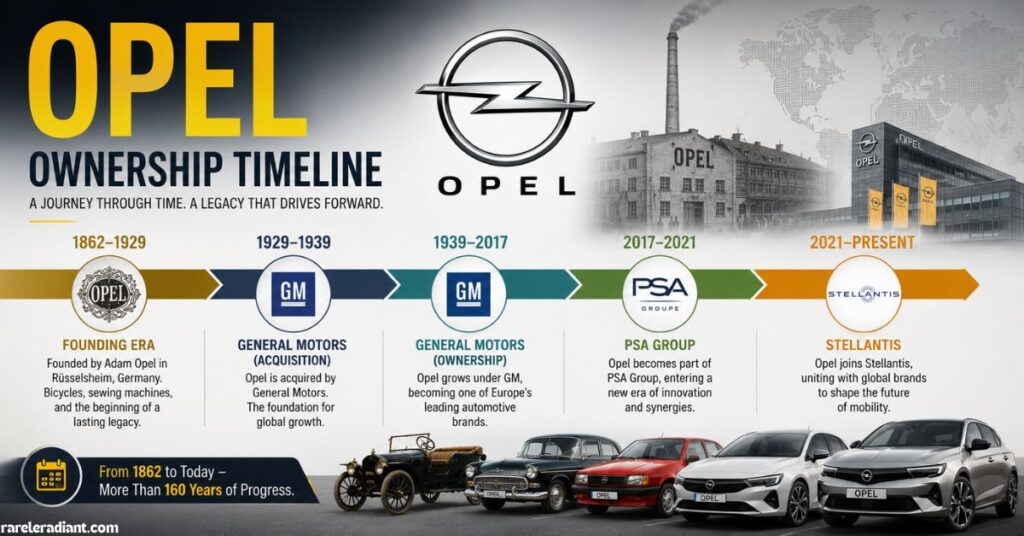
Ownership has changed several times throughout Opel’s long history. Despite those changes, the company’s engineering center and brand identity have remained firmly rooted in Germany.
The General Motors Era
In 1929, General Motors (GM) acquired an 80% stake in Opel. By 1931, GM owned the company outright.
This partnership lasted for more than 85 years.
During this period, Opel expanded production, introduced new technologies, and became one of Europe’s largest automobile manufacturers.
Acquisition by Groupe PSA
In 2017, France’s Groupe PSA purchased Opel from General Motors.
The acquisition marked one of the biggest changes in Opel’s modern history.
Under PSA, Opel improved profitability while accelerating development of electrified vehicles.
Becoming Part of Stellantis
In 2021, Groupe PSA merged with Fiat Chrysler Automobiles to create Stellantis.
Today, Opel operates as one of Stellantis’ European brands.
This partnership provides access to:
- Shared engineering platforms
- Advanced electric vehicle technology
- Global manufacturing resources
- Expanded research and development
Although ownership has evolved, Opel continues designing vehicles that reflect its German heritage.
How to Pronounce Opel Correctly
Many English speakers wonder how to pronounce the brand correctly.
English Pronunciation
In English, Opel is commonly pronounced as:
OH-pel
Phonetic spelling: OH-pel
German Pronunciation
In German, the pronunciation sounds slightly different:
OH-puhl
The first syllable receives the primary emphasis.
Common Pronunciation Mistakes
People sometimes pronounce Opel incorrectly by saying:
- Oh-PEEL ❌
- Op-ELL ❌
- O-PAL ❌
The correct pronunciation remains close to OH-pel, regardless of the language.
Why Is Opel Popular in Europe?
For more than a century, Opel has maintained a loyal customer base throughout Europe.
Its popularity isn’t based on flashy marketing alone. Instead, it comes from consistently delivering vehicles that meet everyday needs.
Reputation for Reliability
Opel vehicles are known for dependable engineering and practical ownership.
Owners often choose Opel because of:
- Durable construction
- Comfortable driving experience
- Reasonable maintenance costs
- Proven safety features
Affordable Engineering
Rather than targeting the luxury market, Opel focuses on delivering value.
Drivers receive modern technology without paying premium-brand prices.
This strategy has made Opel especially attractive to:
- Families
- First-time buyers
- Fleet operators
- Small businesses
Market Presence Across European Countries
Opel maintains a strong presence in many European markets.
Its vehicles are commonly seen in:
- Germany
- Spain
- Italy
- Austria
- Switzerland
- Belgium
- Poland
- Hungary
- The Netherlands
In the United Kingdom, many Opel models have historically been sold under the Vauxhall brand with similar engineering.
Opel vs. Other European Car Brands
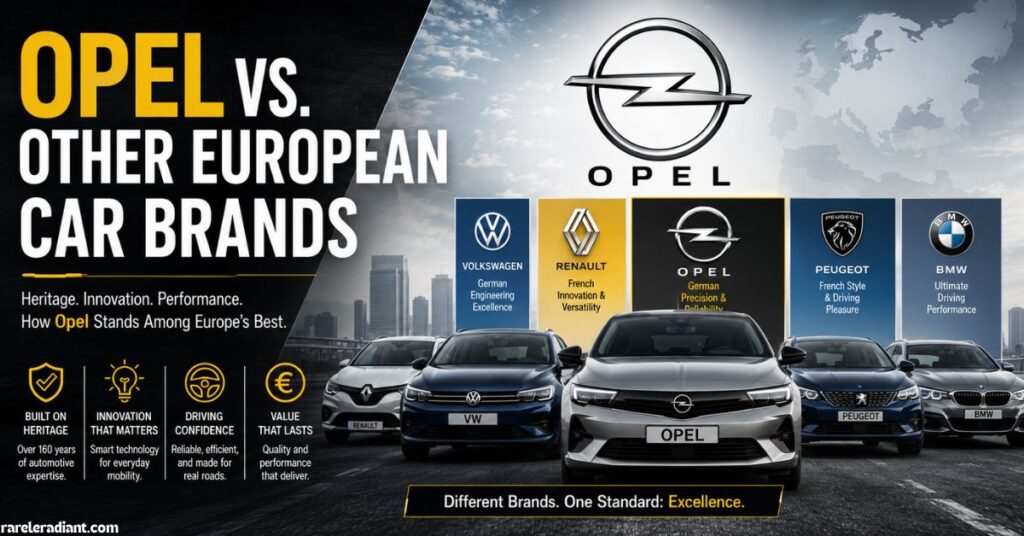
Europe is home to some of the world’s most respected automobile manufacturers.
So where does Opel fit?
Opel vs. Volkswagen
| Opel | Volkswagen |
|---|---|
| Value-focused | Slightly more premium positioning |
| Competitive pricing | Broader global market presence |
| Practical engineering | Wider luxury technology options |
Opel vs. Peugeot
Since both brands belong to Stellantis, they share certain platforms.
However, they maintain distinct identities.
- Opel emphasizes German engineering.
- Peugeot focuses heavily on French styling and interior design.
Opel vs. Renault
Renault has strong market share across Europe.
Opel often competes by offering:
- Conservative styling
- Practical interiors
- Comfortable driving dynamics
- Competitive ownership costs
What Makes Opel Different?
Several characteristics distinguish Opel from competitors.
- More than 160 years of history
- German engineering heritage
- Practical vehicle design
- Strong value for money
- Continuous investment in electric mobility
These qualities continue attracting drivers who value reliability over luxury branding.
Interesting Facts About Opel
Even longtime car enthusiasts are often surprised by Opel’s history.
Here are some fascinating facts.
- Opel was founded in 1862, making it one of the oldest surviving automotive manufacturers.
- The company originally produced sewing machines, not automobiles.
- Opel became one of the world’s largest bicycle manufacturers before entering the automotive industry.
- Adam Opel never saw an Opel automobile because he died in 1895, four years before the company’s first car.
- The famous lightning bolt logo was inspired by the Opel Blitz truck.
- Opel has produced millions of vehicles that have been sold across Europe and beyond.
- The company is now part of Stellantis, one of the world’s largest automotive groups.
These milestones highlight why Opel meaning extends beyond a simple family name. It represents more than a century and a half of industrial innovation.
Frequently Asked Questions About Opel Meaning
What does Opel mean?
Opel is the surname of founder Adam Opel. It is not an acronym or abbreviation.
Is Opel named after a person?
Yes. The company takes its name from Adam Opel, who founded the business in 1862.
Is Opel still a German brand?
Yes. Although Opel is owned by Stellantis, it remains a German automotive brand with headquarters in Rüsselsheim am Main, Germany.
Who owns Opel today?
Opel is currently owned by Stellantis, the multinational automotive company formed in 2021 through the merger of Groupe PSA and Fiat Chrysler Automobiles.
What is Opel famous for?
Opel is best known for:
- Affordable passenger vehicles
- German engineering
- Compact cars
- SUVs
- Electric vehicle development
- The Opel Corsa and Opel Astra
Does Opel sell cars outside Europe?
Yes. While Europe remains Opel’s primary market, selected models are available in additional international markets depending on regional business strategies and partnerships.
Key Takeaways
If you only remember a few points from this guide, make them these.
| Topic | Summary |
|---|---|
| Opel meaning | The surname of founder Adam Opel |
| Founded | 1862 |
| Country of Origin | Germany |
| Founder | Adam Opel |
| Original Products | Sewing machines |
| Bicycle Production | Began in 1886 |
| First Automobile | Produced in 1899 |
| Current Owner | Stellantis |
| Headquarters | Rüsselsheim am Main, Germany |
| Best-Known Model | Opel Corsa |
Conclusion
Understanding the Opel meaning reveals much more than the origin of a famous automotive brand. The name comes directly from Adam Opel, whose vision and craftsmanship laid the foundation for one of Germany’s most enduring industrial companies.
What began as a small sewing machine workshop in 1862 evolved into a bicycle manufacturing powerhouse before becoming a respected automobile producer. Along the way, Opel embraced innovation, introduced mass production techniques, and created vehicles that millions of drivers have trusted for generations.
Today, Opel continues to build on that legacy as part of Stellantis. Its focus on practical engineering, modern technology, and accessible mobility keeps the brand relevant in a rapidly changing automotive landscape.
Whether you searched for Opel meaning out of curiosity or to learn about the company’s history, one fact stands out above all else: Opel is more than a name. It represents over 160 years of German engineering, industrial progress, and a commitment to making transportation better for everyday people.

Ilona Leijer is a seasoned content creator with over 4 years of experience specializing in witty puns, clever jokes, wordplay and engaging humor. His creative work is the driving force behind Rarele Radiant , a platform dedicated to bringing laughter, creativity, and memorable content to readers around the world.